


Generating dental leads doesn't matter if they don't become patients. Learn how to fix leaks in your revenue chain and grow your practice with Xpress.

Most dental marketing companies spend a lot of time talking about leads, clicks, impressions and cost per lead. We track all of that too. But none of it matters much if the leads do not turn into patients and production. That is where I think a lot of dental marketing goes sideways. A practice can spend more money, generate more calls and still not grow. You can have good ads, a good website and plenty of demand, but if calls are being missed, leads are not being followed up with, the schedule cannot handle the patients, or nobody really knows what happened to the leads, more marketing is not necessarily going to fix the problem. Sometimes it just gives you more of the same problem. That is a big part of how we look at marketing at Xpress. The ad is only one part of the system When we look at a practice, we are looking at the whole path: Marketing → Lead → Contact → Scheduling → Arrival → Treatment → Revenue There can be a leak anywhere along that path. Maybe the ads are weak. Maybe the landing page is weak. Maybe you are getting leads but taking too long to call them. Maybe the phones are not being answered. Maybe patients are scheduling but not showing. Maybe they are showing but treatment is not being accepted. Those are completely different problems, and they require completely different solutions. If all you are looking at is the ad account, you can miss most of what is actually happening. I will give you a real example. We had a multi-location dental group where one office was answering calls, working the tracking sheet every day, and had providers ready to see more patients. Another office in the same group, five miles away, had a high missed call rate, barely touched the tracking sheet, and had no consistent follow-up process. Both were getting the same type of marketing. Both had ads running. But one office was turning leads into scheduled patients and the other was letting them disappear. On a call with the group, the regional manager confirmed it: "The spreadsheet is getting done at one location because Stacy actually owns it. At the other location, I ended up filling it out myself because nobody was keeping up." That is the kind of thing that changes how you spend money. You do not pour budget into an office that is not ready to handle the calls. You push harder where the system is working and you fix the leak where it is not. More leads are not always the answer One of the first questions clients naturally ask when they want to grow is: "Should we spend more?" Maybe. But not automatically. If an office is answering its calls, following up quickly, tracking its leads and has room on the schedule, then increasing the marketing can make a lot of sense. If another office is missing half its calls and has no consistent follow-up process, pouring more money into that office may just mean paying for more opportunities to be lost. That is not a marketing strategy I would recommend. Fix the leak first. Then scale. I had this conversation recently with a practice owner who was frustrated that production had not moved despite increasing the ad budget. When we sat down and actually listened to the calls and reviewed the tracking data, the picture got clearer fast. The practice had gone through staff turnover. A key office manager had essentially checked out, what you might call quiet quitting, and lead follow-up dropped off a cliff. The team was supposed to make at least three follow-up attempts on every missed or unreturned lead. They were barely making one. The owner said it directly: "Marketing's job is to generate the leads. Our job is to convert them. And I know we have not been doing our part." That kind of honesty is rare. And it is exactly the kind of conversation where real progress starts. This gets even more important with multiple locations We work with a lot of multi-location dental groups, and one thing becomes obvious very quickly: every office is different. You can have one location that is ready to grow aggressively and another that absolutely is not. One may have great phone handling and available providers. Another may have staffing issues. One may have a huge opportunity in pediatric because there are almost no pediatric-certified competitors in that radius. Another may be better suited for emergency, implants or general dentistry. One office may follow the tracking process religiously. Another may barely touch it. So we do not believe in simply copying the same campaign across ten locations and assuming they should all perform the same way. There should be consistency in the system. There also has to be judgment at the individual office level. On one recent call with a dental group relaunching ads across multiple offices, we mapped it out location by location. One office was the clear growth candidate because they answer calls, work the tracking sheet, and need patients. Another location had such a high missed call rate and weak follow-up that we recommended holding their budget flat until the call handling improved. A third had major pediatric opportunity because there was almost no local competition, but needed a controlled ramp so the team could adjust. We told them: "September launch does not mean you have to force the full month-one spend at every office. Budgets can ramp organically. If an office is not ready, we protect the money until they are." That is a conversation most agencies do not have, because it means recommending you spend less. We care about what happens after the lead comes in This is probably one of the biggest differences in how we work. We build websites. We run Google Ads and Meta Ads. We do SEO, direct mail and landing pages. We build tracking and attribution systems. We use AI and automation to help with follow-up and lead recovery. But our job does not end when somebody fills out a form or calls the office. We want to know what happened next. Did anyone answer? Did somebody call them back? How long did it take? Did they schedule? Did they show? Was the lead actually qualified? Did the treatment turn into production? Because ultimately, that is what the practice cares about. Not whether Google says there were 37 conversions this month. Here is a real scenario. We had an office where lead volume looked fine on paper but the office manager flagged that nearly every other lead was asking for free dental work, Medicaid services, or grant-funded treatment. The campaign was generating calls, but the calls were not the right patients. When we dug in, we found the ad copy and keyword targeting needed additional negative keyword layers, and the automated follow-up scripts were going out in English even for a campaign targeting Spanish-speaking patients. On the same call, we discovered that the implant lead automation was broken. Leads were coming in with blank contact information. The office had been trying to follow up on leads that literally had no phone number attached. That is the kind of thing you only catch when you actually care about what happens after the click. Marketing problems and office problems are not the same thing This distinction matters. Sometimes marketing is the problem. The campaign may be targeting the wrong patients. The offer may be weak. The cost per click may be too high. The landing page may not convert. The strategy may simply be wrong. We own those problems. But sometimes marketing is producing the opportunity and the breakdown happens inside the office. Calls are missed. Voicemails are not returned. Nobody owns follow-up. Tracking is incomplete. The schedule is not set up to accommodate the patients being marketed. Those are operational problems. And pretending otherwise does not help anybody. We are not interested in blaming the office. We are interested in finding out what is actually stopping growth. If it is us, we need to fix it. If it is inside the practice, we need to identify it clearly so the practice can fix it. That is how you get somewhere. Tracking has to go beyond lead count I am a big believer in tracking. Probably to an annoying degree. But there is a reason. Without tracking, everyone starts operating on opinions. Marketing says the campaign is working. The front desk says the leads are terrible. The owner says production has not increased. Nobody actually knows what happened. That is a bad place to manage from. We want to connect the pieces as far down the chain as we reasonably can. Where did the lead come from? Was it answered? Was it qualified? Was it scheduled? Did the patient arrive? That gives us a much better picture of whether the marketing is working and, just as importantly, where it is not working. One thing we learned the hard way: when a group finally got their August scheduling data completed across all offices for the first time in years, it changed the entire conversation. Suddenly we could see which offices were converting leads and which were just collecting them. Arrival tracking was still not done, but even having the scheduling data was a breakthrough. It turned a guessing game into an actual growth conversation. The tools help. They do not fix everything. There are more tools available to dental practices today than ever before. Call tracking. CRM systems. AI voice. Automated texting. Lead nurturing. Dashboards. Attribution systems. We use a lot of them. They are useful. But I also think the industry can get carried away pretending technology fixes everything. It does not. AI cannot make your team care about calling a patient back. A dashboard cannot make somebody answer the phone. Call tracking does not fix bad scheduling. A better website does not fix weak case acceptance. Technology can make a good system much better. It can also make a broken system easier to measure. You still have to fix the actual problem. This is why we think of Xpress as a growth partner We have been doing dental marketing since 2005. Xpress actually started because we needed better marketing for our own family dental practice. So a lot of this was learned the hard way. Running campaigns. Answering phones. Dealing with vendors. Hiring people. Watching leads get mishandled. Trying things that worked. Trying things that did not. Tracking the difference. That experience shapes how we look at clients today. We do not see the website over here, Google Ads over there and SEO somewhere else. It is one system. The website needs to convert the traffic. The advertising needs to create the right demand. The tracking needs to tell us what happened. The follow-up needs to keep opportunities from disappearing. And the office has to be capable of turning those opportunities into patients and treatment. When those pieces work together, marketing can have a huge impact. When they do not, throwing more leads into the top of the funnel usually is not the answer. Who we work best with This approach is not right for every dental practice. The offices we tend to work best with want to know what is actually happening. They want growth, but they also want accountability. They are willing to look at the marketing and the internal process. They understand that Xpress has responsibilities and their team has responsibilities. And if something is broken, they would rather identify it and fix it than spend six months arguing about whose fault it is. That is the kind of relationship where we can do our best work. The bottom line Dental practices do not grow because they got more clicks. They grow because the entire system works: You attract the right patient. You capture the lead. You respond. You schedule them. They show up. You diagnose treatment. They accept treatment. That is the actual revenue chain. Our job at Xpress is to help practices understand that chain, find the leaks and improve the parts we can influence. Sometimes that means better marketing. Sometimes it means better follow-up. Usually it is some combination of both. If your marketing is generating activity but the practice is not seeing the growth you expected, I would not automatically assume you need more leads. First, figure out where the leads you already have are going. That is usually a much better place to start.

Is your dental practice's social media stuck on autopilot? Discover 3 practical ways to refresh your fall social media strategy, boost engagement, and attract more patients.

In dental marketing, a lot of agencies want the story to be simple. They want it to sound like this: spend more, get more leads, celebrate the graph, move on. That is not this story. This story is better because it is more honest. An established dental practice went into spring 2026 frustrated. The monthly marketing budget had already been pushed to roughly $12,000 , but the office was not feeling enough visible improvement from that spend. The issue was not just whether leads existed on a report. The issue was whether those leads were turning into the kind of real patient movement the office actually cared about: qualified opportunities, scheduled patients, arrivals, treatment presented, treatment accepted, and money collected. That is where the work began. The answer was not to keep raising the budget. The answer was to make the existing patient-acquisition system perform better . That meant stepping back and dealing with the messy truth that most practices face: marketing performance is not just about ad clicks. It is about what happens from the first search all the way through the phone call, the scheduling process, the show-up rate, the treatment conversation, financing approval, and whether the case actually closes. So instead of selling a fantasy, the approach shifted toward something more practical. The first move was to stop treating the account like a black box and start tightening the line from lead → qualified lead → schedule → arrival → treatment value . The team reviewed not only lead counts, but also what type of patient intent was coming in, what converted, what did not, and where the friction lived. What emerged was important. The office was not simply attracting one narrow patient type. It was bringing in a mix of urgent pain-driven patients, “need a dentist now” patients, and broader general-intent patients looking for a practice they trusted. Some of the highest-value cases did not come in asking for implants or full-mouth rehab. They came in because someone had a broken tooth, tooth pain, swelling, a bad previous experience somewhere else, or an immediate need for care. That insight matters, because it changed how the marketing had to work. Instead of over-filtering in Google Ads and driving costs up, the strategy moved toward controlled optimization : tighter landing-page iteration stronger call-focused conversion structure messaging built around how patients actually described their problems better use of office feedback closer review of which lead types were producing real value less guesswork and more operating from observed reality This was not an overnight flip. It was a measured process. There were weekly reviews. Campaign changes had to be made carefully. The team avoided swinging wildly because overcorrection can damage what is already working. Some weeks were stronger than others. Seasonality mattered. Holidays mattered. Market costs fluctuated. Certain lead types were more expensive. Some leads looked promising and failed on financing. Some opportunities depended heavily on who in the office was presenting treatment. Some website leads were harder to follow up with, but when they converted, they sometimes produced oversized case value. That is the real story. Better marketing did not erase the complexity. It worked by getting tighter around it. And the numbers show what happened. From April to August 2026 , while the monthly budget stayed flat at $12,000 , total leads rose from 120 to 230 , a 92% increase . Unique leads rose from 116 to 221 , up 91% . Qualified leads increased from 83 to 170 , a 105% gain . Just as important, the qualified lead rate improved from 69% to 74% . That last number matters more than most people realize. It means the practice was not just opening the floodgates and accepting worse traffic to make the lead count look better. The growth came with an increase in quality. And it did not stop at the top of the funnel. Scheduled patients rose from 34 to 70 , a 106% increase . Arrivals went from 17 to 45 , up 165% . Treatment presented increased from $122,080 to $251,105 , up 106% . Treatment accepted rose from $49,070 to $105,728 , an increase of 115% . That is why this should not be framed as a basic lead-generation case study. It is a patient-acquisition optimization case study . The better framing is not “we got more leads.” The better framing is: the practice nearly doubled lead volume on the same budget, improved qualified lead volume and qualified rate at the same time, and carried that improvement deeper into scheduling, arrivals, treatment, and same-month collections. That deeper carry-through is the difference between vanity performance and meaningful performance. There is also an ROI story here, but it needs to be stated carefully. Across March through August 2026 , the practice spent $72,000 on marketing and generated $404,312 in same-month collected treatment tied to that spend, for an average of 5.62X same-month collected ROI . August was the strongest month in that six-month period, with $104,808 collected and approximately 8.73X same-month collected ROI . Again, this is not lifetime value. It is not padded with future hygiene, future restorative work, or treatment completed in later months. That is why it is a useful and conservative number. If anything, it understates the long-term business value, because dentistry often realizes additional revenue after the initial month. But the same-month snapshot is the more disciplined way to tell the story. Just as important as the numbers are the limitations and realities that sat underneath them. The meetings made that clear. This office had to deal with real-world conversion friction: variable scheduling performance, mixed staff capacity, downstream financing issues, inconsistent follow-up resources, case-mix swings, and the difference between what marketing can control and what the office has to own internally. In other words, the gains did not happen because someone found a magic keyword. They happened because the acquisition system got better. The campaign strategy got sharper. The messaging got closer to real patient intent. The office feedback loop improved. The team paid attention to lead quality, schedules, and arrivals instead of hiding behind click metrics. And the results stacked. That is the kind of growth story more dental practices need to understand. If a practice has a leaky system, spending more money often just pours more volume into the leak. But if the system gets tighter — better targeting, better conversion structure, better intake alignment, better follow-up, better treatment flow — then the same dollars can do a lot more work. That is what happened here. No budget increase. Just better performance from the budget that was already there. And by August, that showed up in one of the clearest ways possible: 230 total leads 170 qualified leads 70 scheduled patients 45 arrivals $251,105 treatment presented $105,728 treatment accepted 8.73X same-month collected ROI Same budget. Stronger system. More real patient movement. That is the story.

Most dental practices do not think they have a tracking problem until the numbers stop making sense. What usually gets blamed first is the obvious stuff. The ads must be underperforming. The budget is too low. The market is soft. The leads are bad. The front desk is not getting enough opportunities. Sometimes those explanations are right. But in a lot of practices, the bigger problem is less dramatic and more dangerous. Small disconnected changes start piling up. A phone number gets changed for consistency. A website has downtime during active campaigns. A lead source starts being classified a different way. A form stops routing properly. A chat tool gets installed without the rest of the reporting flow being reviewed. Several people touch the website, the ad account, and the tracking setup without one clear approval path. None of those changes look major on their own. But together, they can make a practice less able to see what is actually driving booked patients. That is the real issue. For a growth-minded dental office, marketing is not just about getting traffic or generating leads. It is about building a system that gives the practice enough visibility to know what is working, what is leaking, and what needs to be fixed next. Once tracking gets muddy, the practice starts managing by partial truth. That is when wasted spend goes up, wrong decisions get made, and growth gets harder than it should be. This is one of the most overlooked problems in dental marketing. Practices assume the big risk is poor campaign performance. In reality, one of the bigger risks is poor measurement and poor change control. If the data cannot be trusted from click to call to form to scheduled patient, then every optimization decision becomes less reliable. That does not just hurt the marketing team. It hurts the practice. Why small changes create big dental marketing problems Most dental offices do not break their growth systems in one major move. They chip away at clarity over time. That usually happens because the office is trying to improve something real. A team member updates the site. Someone cleans up the phone number for NAP consistency. A tool gets added to improve chat handling. A reporting workflow gets adjusted so calls can be categorized better. A campaign gets paused and restarted. On paper, none of this sounds reckless. The problem is that every change affects a system that is already interconnected. Dental marketing is not just ads. It is not just SEO. It is not just the website. It is not just call tracking. It is the entire revenue chain working together: the traffic source the landing page or website page the lead capture path the phone routing setup the form handling flow the chat or AI follow-up experience the reporting layer the scheduling process inside the office the final conversion into a kept appointment and an accepted case When people make changes to one part of that chain without checking the downstream impact, the office can lose visibility without realizing it. This is why a practice may feel like marketing is getting harder even when lead volume looks similar. The issue may not be that demand disappeared. The issue may be that the practice can no longer cleanly see which channels are driving calls, which leads are real opportunities, and which parts of the system are quietly dropping patients before they book. The danger is not just confusion. The danger is false confidence. Once a report starts looking cleaner than reality, the office becomes more likely to trust the wrong conclusions. What website downtime really costs a dental practice Website downtime is usually treated like a technical inconvenience. It is more serious than that. For a dental practice running active Google Ads, Meta Ads, local SEO campaigns, or branded search traffic, the website is not just an online brochure. It is part of the lead intake system. When the site is down, unstable, hacked, loading incorrectly, or partially broken, the office is not just dealing with an IT problem. It is dealing with a revenue interruption. Think through the chain reaction. A paid campaign keeps spending. Search demand still exists. Patients still click. But the landing experience is weak, broken, or unavailable. What happens next? Some users leave immediately. Some do not trust the brand enough to continue. Some never make it to the phone number or contact form. Some try again later and are lost to a competitor. Some convert through another path that is harder to attribute back to the original source. That means downtime can distort both performance and reporting at the same time. The performance hit is obvious: fewer conversions. The reporting hit is less obvious: a less accurate picture of how channels actually influenced patient action. For dental practices, this matters even more because treatment decisions are often high intent and time-sensitive. A patient looking for veneers, emergency dentistry, sedation, implants, or a second opinion may not come back later just because the site was unavailable for a few hours. That patient may move on. This is why website reliability should be treated like part of growth infrastructure, not a side issue. If a practice is actively investing in marketing, the website has to be protected like a business-critical asset. That means: uptime monitoring security controls change logs a clear owner for site edits fast rollback capability a process for checking forms, chat, and phone visibility after updates A practice that spends thousands on traffic but does not protect the website experience is leaving too much to chance. Why phone number changes and NAP cleanup can create attribution problems Dental practices are often told to keep their business name, address, and phone number consistent across the web. That advice is generally correct. NAP consistency matters for local visibility. But there is an important nuance. If the office changes phone-number usage on the website without understanding how the tracking setup works, it can create a different kind of problem: attribution drift. This happens when a practice has call tracking, dynamic number insertion, multiple source-based phone numbers, or conversion routing that depends on a specific configuration. A well-intentioned change to “clean things up” can accidentally break how calls are being attributed. Then the office sees one or more of these issues: direct calls do not get captured properly leads show up under the wrong source a “null” or unknown category grows reporting no longer reflects the actual patient path certain campaigns start looking weaker or stronger than they really are That is a serious issue because the office will often respond to the report, not the root cause. If paid search suddenly looks worse, the assumption may be that the ads declined. If organic seems soft, the office may question SEO. If call volumes appear to shift, the team may change budgets or messaging. But what if the real problem is that the underlying attribution map is now broken? This is where a lot of offices make expensive mistakes. They optimize around reporting artifacts instead of real behavior. Local SEO best practice and call-tracking best practice both matter. The answer is not to ignore one in favor of the other. The answer is to manage the tradeoff intentionally. A growth-minded dental practice should ask: Which phone number is being shown where? Which systems rely on that number to record source data? What happens to attribution if we standardize or replace it? Have we tested calls from multiple source paths after the change? Who approved the update, and was the marketing/tracking owner involved? Those are not overcomplicated questions. They are basic control questions. Practices that ask them early avoid a lot of downstream confusion. Why a better conversion rate does not always mean better performance One of the easiest ways to misread dental marketing is to celebrate a cleaner metric without asking what changed underneath it. A practice sees a higher conversion rate and assumes improvement. That seems logical. But it is only valid if the definition, classification, and capture method stayed consistent. If call outcomes are being labeled differently, if certain interactions are excluded, if low-quality calls are filtered in a new way, or if lead categories are being managed more tightly by hand, the conversion rate can improve on paper without the actual process improving in real life. That does not mean the metric is useless. It means the metric needs context. This is especially important in dental because the gap between a reported lead and a real revenue opportunity is large. A click is not a call. A call is not a qualified lead. A qualified lead is not a scheduled patient. A scheduled patient is not a show. A show is not a treatment acceptance. When offices skip over that chain, they become vulnerable to vanity wins. A higher conversion rate can mean: better campaign targeting a stronger landing page improved front-end offer fit tighter call classification narrower definitions broken or changed reporting logic less noise in the denominator Some of those are real improvements. Some are reporting improvements. Some are measurement distortions. A good operator wants to know which one happened. This is where Xpress-style thinking matters. The goal is not to chase good-looking dashboards. The goal is to understand what moved revenue. If a practice is seeing a performance spike, the right first question is not “How do we celebrate this?” The right first question is “What changed, and how confident are we that this reflects actual improvement?” That mindset protects the practice from false optimism. Why change control matters more than most dental offices think A lot of dental practices do not have a change-control problem because they are careless. They have it because they are busy. The owner is focused on production. The office manager is solving daily fires. The front desk is buried in phones and patients. A vendor is adjusting ad settings. Someone on the website side wants to clean up messaging. A team member changes a plug-in or contact point. A new tool gets tested. Individually, these are normal business actions. The problem is that no one is acting as the final gatekeeper over the full growth system. Without that gate, the office ends up with: multiple people making edits inconsistent communication unclear ownership of outcomes surprise changes to site content or contact paths reporting discrepancies that surface too late finger-pointing when results shift Change control sounds bureaucratic until you compare it to the alternative. The alternative is making business decisions from a system that several people keep altering independently. For a dental office, change control does not have to be complicated. It just has to be disciplined. A simple process can solve most of this: One person owns final approval for website and campaign-impacting changes. Every proposed change gets routed through that person before launch. Anything touching phone numbers, forms, chat, conversion tracking, or landing pages gets tested after the update. The office logs what changed and when. Reporting shifts get reviewed against the timing of those changes. That does not slow growth down. It protects growth. Practices that skip change control usually think they are moving faster. In reality, they are often creating invisible rework. Weeks later, the team is trying to diagnose why reporting no longer matches reality, why lead quality appears different, or why channel performance suddenly looks off. That is a preventable problem. The real goal is not more reports. It is clearer operational truth. A lot of marketing conversations drift toward dashboards because dashboards are easier to look at than operations. But dental growth does not happen inside reports. It happens inside a messy chain of marketing, lead handling, scheduling, showing, presenting, and case acceptance. That is why the best-performing practices usually do not just ask, “How many leads did we get?” They ask better questions: Which channels are producing qualified opportunities? Which service lines are generating the right patients? Where are leads leaking out? Are calls being answered the right way? Are forms getting fast follow-up? Are chats being handled properly? Are we measuring booked patients or just inquiries? What changed in the system before this trend appeared? Those questions produce better decisions because they connect marketing to operations. This matters a lot in dental because many growth issues are not caused by one bad tactic. They are caused by friction across the system. Traffic might be fine. The offer might be fine. The site might even be decent. But if the attribution is unclear, the office phone handling is uneven, and the reporting definitions keep shifting, the practice will still struggle to know what to fix first. That is why clean systems are a competitive advantage. Not because they look impressive. Because they reduce wasted motion. When a practice has cleaner tracking, clearer ownership, and more disciplined changes, it can move faster with better judgment. It knows which campaigns deserve more budget. It knows which pages or offers need work. It knows when a drop is real and when the measurement is suspect. It knows whether the problem is traffic, conversion, follow-up, or attribution. That is how growth becomes more controlled. What growth-minded dental practices should do next If this article sounds familiar, the answer is not to panic. The answer is to tighten the system. Start with a practical review. 1. Audit the current tracking path Map how a patient gets from click to contact to scheduled appointment. Review: paid search call tracking website phone-number behavior form routing chat and chatbot paths Google Ads conversion setup CRM or call-tracking platform classifications reporting categories that include “unknown,” “null,” or direct traffic You are looking for gaps, not perfection. 2. Review recent changes before diagnosing channel performance Before concluding that ads, SEO, or lead quality changed, ask what changed operationally. Check: website edits security incidents or downtime plug-in changes phone-number swaps tracking script changes lead-source classification updates campaign restructuring This single habit can prevent a lot of false conclusions. 3. Set a change-control owner Pick one point person who must approve anything that affects the website, contact paths, tracking, or campaign structure. That person does not need to do every task. They need to control the sequence and protect the integrity of the system. 4. Stop treating reported leads as the final success metric Track deeper into the process. If possible, separate: inquiries qualified leads scheduled patients show rate treatment acceptance by service line The more the office can connect marketing to actual booked and kept opportunities, the better its decisions will be. 5. Protect the website like growth infrastructure If the site is supporting active lead flow, treat uptime, security, and form functionality as operational priorities. A broken or unstable site does not just hurt branding. It disrupts revenue capture. 6. Question “good news” with the same rigor as bad news When a metric improves, do not just ask what went right. Ask what changed. The practices that grow most steadily are the ones that investigate positive anomalies just as seriously as negative ones. Final takeaway Most dental marketing problems do not start with one catastrophic mistake. They start with small changes that make the system harder to trust. A website goes down. A phone setup changes. A reporting method shifts. A team cleans up one detail without checking the effect on attribution. Different people make disconnected decisions in different systems. Then the practice is left trying to judge performance with blurred visibility. That is when marketing starts to feel unpredictable. Not because growth is impossible. Because the office is trying to optimize from incomplete truth. The practices that win long-term are usually not the ones with the flashiest campaigns. They are the ones with cleaner systems, tighter change control, better attribution discipline, and a stronger connection between marketing activity and real patient outcomes. That is the standard worth building toward.

Discover how direct mail postcards help dental practices build brand recognition, attract new patients, and stay top of mind. Learn why postcards remain one of the most effective local marketing tools.

From the desk of Shawn Kimmel

Why New Movers Matter in Dental Marketing
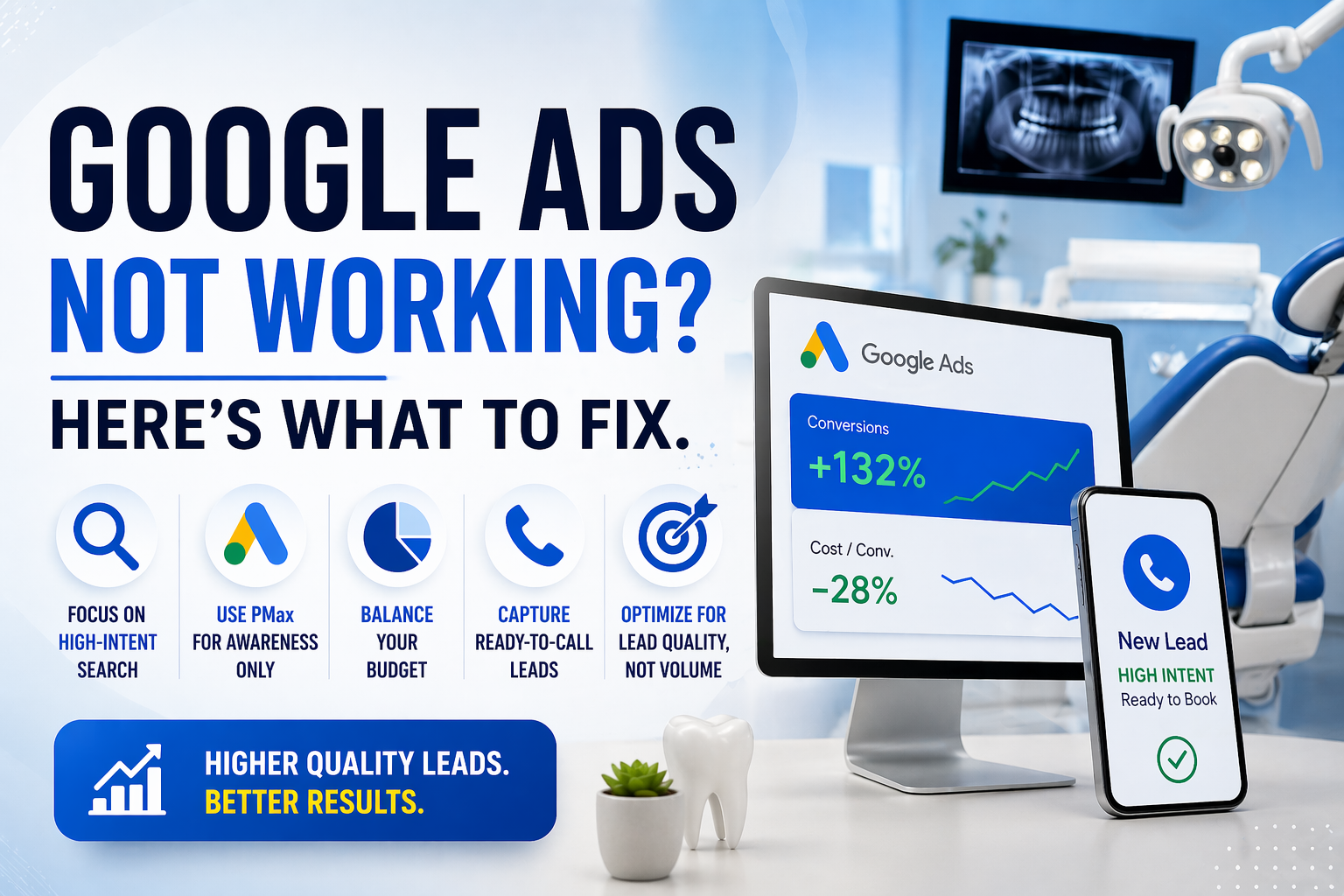
If your Google Ads campaigns aren’t delivering results , you’re not alone. Many dental practices are seeing rising costs, increased competition, and fewer qualified leads. But here’s the truth: Google Ads still works extremely well for dental practices—when it’s built and optimized correctly. If your campaigns feel like they’ve slowed down or stopped producing, it’s usually not the platform. It’s the strategy behind it . Why Are Google Ads Not Working for Dentists? (Quick Answer) Google Ads typically fails when campaigns focus on low-intent traffic, poor budget allocation, and lack of conversion optimization. Practices that succeed focus on high-intent search traffic, strong landing pages, and clear conversion paths . Where Most Dental Google Ads Campaigns Go Wrong 1. Over-Reliance on Low-Intent Channels Many practices invest heavily in display ads, YouTube, or broad targeting campaigns. While these can increase visibility, they rarely generate ready-to-book patients . Problem: You’re paying for attention, not action. 2. Too Much Budget in Awareness Campaigns Brand awareness has its place—but most dental practices don’t need to prioritize it. If a large portion of your budget is going toward awareness: You’ll see impressions Maybe clicks But very few real leads 3. Heavy Dependence on Performance Max Campaigns Performance Max campaigns can be useful—but they’re often overused. Common issue: Limited control over targeting Mixed intent traffic Harder to optimize for quality leads Used alone, they can drain budget without delivering strong ROI. 4. No Conversion-Focused Strategy Clicks don’t mean anything without conversions. Many campaigns fail because: Landing pages aren’t optimized No strong call-to-action No clear next step for the patient 5. No Clear Path for High-Intent Leads If someone searches: “Emergency dentist near me” “Dental implants cost” They’re ready to act. But if your campaign doesn’t: Prioritize these keywords Direct them to the right page Offer an immediate way to contact you You lose the lead. What Actually Works in Dental Google Ads 1. Prioritize High-Intent Google Search Campaigns Search campaigns targeting keywords like: “Dentist near me” “Emergency dentist [city]” “Dental implants [location]” These capture users actively looking for care right now . This is where the highest ROI lives. 2. Use Performance Max the Right Way Instead of relying on it fully: Use it as support for awareness Retarget previous visitors Reinforce your brand presence Think of it as a supporting channel , not the foundation. 3. Balance Your Budget Strategically A strong setup typically looks like: Majority in Search (high intent) Smaller portion in retargeting Minimal spend on awareness This ensures your budget is aligned with patient acquisition—not just visibility . 4. Add Call-Focused Campaigns Many patients don’t want to fill out forms. They want to call immediately . Call-focused campaigns: Capture urgent patients Increase conversion speed Improve lead quality Especially effective for: Emergency dentistry Same-day appointments 5. Optimize for Lead Quality—Not Just Volume More leads ≠ better results. You want: Patients who show up Patients who accept treatment Patients who can afford care This means: Refining keywords Filtering traffic Improving targeting How to Generate High-Intent Dental Leads with Google Ads If you want consistent results, your campaigns should be built around: Search-first strategy Location-based targeting Service-specific landing pages Strong offers or incentives Clear calls-to-action (Call Now, Book Appointment) Every part of your funnel should guide the user toward taking action quickly . The Real Shift in Google Ads Strategy Google Ads is no longer about: Getting as many eyes as possible. It’s about: Showing up at the exact moment a patient is ready to book. That’s the difference between: Wasting budget vs. Filling your schedule Signs Your Google Ads Campaign Needs Fixing If you’re experiencing any of the following, your setup likely needs adjustment: High cost per lead Low conversion rates Lots of clicks but few calls Poor-quality leads Patients not showing up These are all indicators of a strategy issue—not a platform issue . Ready to Improve Your Google Ads Results? If your campaigns aren’t performing the way they should, there are likely missed opportunities in your setup . From keyword targeting to landing page optimization, small changes can make a significant impact on: Lead quality Conversion rate Cost per patient Next Step: Fix Your Strategy Want to go deeper into building a system that actually works? Final Takeaway Google Ads is still one of the most powerful tools for dental practices. But success comes down to: Strategy Structure Intent If your campaigns aren’t working, don’t abandon the platform. Fix the foundation—and the results will follow.

You have built something impressive. Your dental practice is producing between $1 million and $3 million annually. You are no longer a beginner. You are established, you are producing, and you have a footprint in your community. However, for many dentists in this bracket, growth starts to feel inconsistent. You might have a record-breaking month followed by a period where things feel tight. This inconsistency is the primary reason many successful practices stall. To move from the $2 million mark toward $4 million and beyond, you have to change your approach from "doing marketing" to "running a growth system." What Actually Moves a Dental Practice Forward Real growth does not come from chasing the latest random marketing tactic. It comes from implementing systems that drive measurable results. If you want to break through your current ceiling, your strategy must focus on four key areas: Consistent New Patient Flow: You need a steady stream of patients rather than occasional spikes that stress your capacity. Stronger Case Acceptance: The goal is high-value treatment starts, not just a high volume of leads. Production Tracking: You must have systems that track actual production and revenue instead of just counting website clicks. Strategic Expansion: Your marketing should actively support hiring new associates, expanding your office, or focusing on higher-end dentistry like implants and full-mouth reconstructions. At Xpress Promotion, we do not guess. We focus on the data to measure what actually produces revenue for your chairs. The Xpress Growth System We have developed a two-phase approach designed specifically for established practices that are ready to scale. Phase 1: Stabilize Patient Flow This phase uses a combination of targeted postcards and paid digital ads to create a foundation of predictability. Predictable Volume: We create a "faucet" of new patients that you can rely on month after month. End-to-End Tracking: We track the entire journey from the initial lead to the scheduled appointment, the arrival, and the final production value. Phase 2: Strengthen Market Position Once your flow is stable, we focus on long-term authority through high-end websites, SEO, and authority content. Upgrade Perception: We ensure your online presence matches the high quality of your clinical work. Increase Case Value: By building authority, you attract patients who are looking for expertise rather than just the lowest price. Search Dominance: We build long-term dominance in local search results so you remain the top choice in your area. Ready to Move from $2M to $4M+? If you are tired of inconsistent months and "random acts of marketing," it is time for a change. You do not need more tactics. You need tracking, you need systems, and you need a growth strategy built for scale. At Xpress Promotion, we help established practices bridge the gap between where they are and where they want to be.